

- CAREER FEATURE
My fight to unlock cannabis and psychedelic drugs for use in medical research
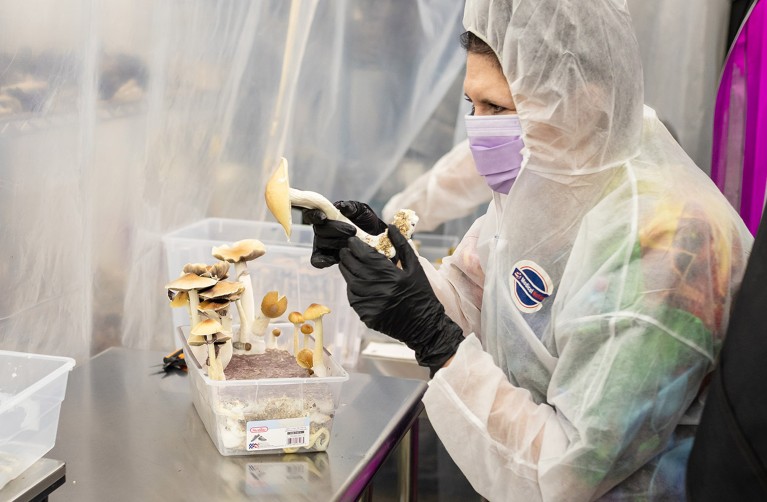
Sue Sisley’s team has grown whole psilocybin-producing mushrooms for clinical trials.Credit: Andrew Neugebauer/STOKE Creative
From the earliest days of her career, physician Sue Sisley has been passionate about caring for US military veterans. Back then, many of the people she treated were self-medicating with black-market cannabis because, unlike prescription drugs, marijuana allayed nightmares and other symptoms of post-traumatic stress disorder (PTSD). A few puffs helped them to fall asleep.
“Initially, I discouraged them and rolled my eyes thinking about it,” says Sisley, whose training taught her to view only approved drugs as medicines. “I lacked sympathy for their claims and thought they were drug seekers.”
Whistleblowing in science: this physician faced ostracization after standing up to pharma
But over time, Sisley saw how the ineffectiveness of mental-health treatments could fuel hopelessness. Currently, 17 US veterans die by suicide daily, on average. The cannabis users among Sisley’s patients were often the ones who maintained a will to live.
“It made me realize that I was very misled, by the government and our training programmes, to believe that cannabis was dangerous,” she says. “I didn’t learn about any medical benefits.”
The early lessons from her patients influenced Sisley. Over the next two decades, she challenged US federal agencies, navigated a legal and regulatory maze and creatively secured funding to investigate and develop treatments, based on cannabis and psychedelics, that the US government had blocked for decades.
A physician-researcher is born
After the US Congress passed the Controlled Substances Act of 1970, cannabis was made illegal and classified as a Schedule I drug, defined as having no accepted medical use. That put marijuana in the same category as heroin and most psychedelic drugs: possession or use of the drug, and growing cannabis without a Schedule I research licence, could land someone in prison.
In the mid-1990s, several US states began defying federal law, allowing adults to purchase cannabis for medicinal purposes. In 2008, when medical marijuana was still off limits in Arizona, Sisley was one of the few physicians who spoke publicly about legalizing it. Her advocacy caught the attention of Rick Doblin, who sought to get certain psychedelic drugs and cannabis taken off Schedule I so that they could be studied and any medical benefits reaped.
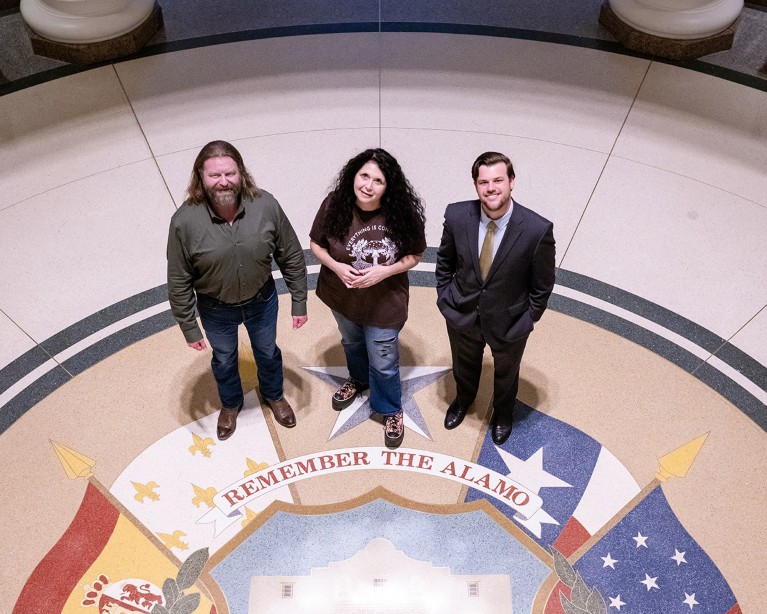
Sisley (centre) visits the Texas state capitol to advocate for research on psychedelics.Credit: Andrew Neugebauer/STOKE Creative
Doblin founded a US non-profit body, the Multidisciplinary Association for Psychedelic Studies (MAPS), to raise money from private donors for clinical trials. He approached Sisley to lead a cannabis study.
Although she lacked a background in research, Sisley was an associate professor of psychiatry and assistant director of telemedicine at the University of Arizona College of Medicine in Phoenix, and Doblin saw her potential. “What really appealed to me is that Sue looks to where science is being blocked by politics, and she’s willing to stand up for what she thinks is right,” he says.
In 2014, Sisley and MAPS received nearly US$2.2 million from the state of Colorado. With approval from the US Food and Drug Administration (FDA), they were poised to lead the world’s first randomized controlled trial of smoked cannabis as a treatment for PTSD in veterans.
But then the University of Arizona declined to renew Sisley’s contract. Although Sisley says that the university simply stated that her services were no longer needed, she thinks there were political pressures involved.
Working Scientist career profiles
“Even though it was legitimate research” and Arizona voters had approved the medical use of marijuana in 2010, Sisley says, “I believe some legislators did not want anything related to cannabis to have a place at the university.”
In the end, however, the termination of her contract “turned out to be a huge gift”, she says. She learnt that she didn’t need a university or hospital to lead the research. In fact, she now thinks the bureaucracy might have slowed her down. In the following two years, Sisley co-founded the Scottsdale Research Institute, purchased a building for it in Phoenix, Arizona, and built a laboratory to begin her study.
In 2016, as she prepared to enrol participants, the cannabis for the study arrived. At the time, the University of Mississippi in Oxford was the sole US government-approved provider of cannabis for use in human research. But when Sisley opened the box, she was horrified. The cannabis was mouldy, pulverized into powder and littered with twigs. It was nothing like the buds sold at dispensaries, and some participants had difficulty in inhaling it because it irritated their throats.
Sisley’s team found that participants who smoked cannabis showed improvement over the placebo group, but not enough to demonstrate statistical significance (M. O. Bonn-Miller et al. PLoS ONE 16, e0246990; 2021). Sisley thought that if participants had access to the cannabis available in dispensaries, they might have tolerated it better and experienced more benefits.
To raise awareness about barriers to cannabis research, Sisley went on a speaking tour (together with Dodger, her guide dog). In 2019, at the South by Southwest conference on music, film, culture and technology in Austin, Texas, she described what was, by then, a ten-year battle to complete her clinical trial, and a move by the US Drug Enforcement Administration (DEA) that might help. In 2016, the agency had announced a policy that aimed to broaden the government’s cannabis supply, so Sisley applied for a Schedule I licence to grow cannabis for a phase IIb trial. But, after two-and-a-half years, the DEA still had not processed her application.
Suing the government for science
Matthew Zorn, an attorney based in Houston, Texas, attended Sisley’s talk. He had become interested in marijuana as a pain treatment while caring for his partner, who later died of bone cancer, and was angered by the red tape surrounding the drug supply for trials. “All Sue was trying to do was advance research. She did everything by the book,” says Zorn. If the cannabis used in a trial “is garbage, of course you can’t prove something is safe and efficacious, and then it’s not going to be available for patients”.
Zorn recruited his colleague Shane Pennington, then also based in Houston, who had experience of bringing cases against federal agencies. Together, representing Sisley pro bono, they helped her to sue the DEA in 2019.
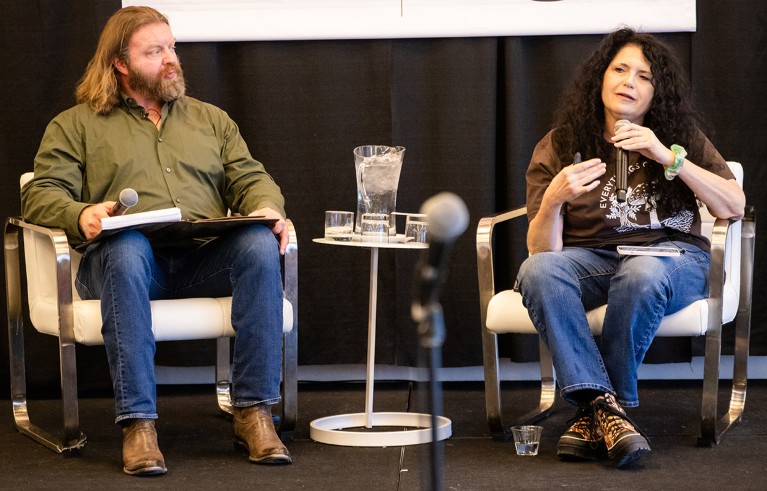
Sue Sisley speaks at the 2025 South by Southwest festival in Austin, Texas.Credit: Andrew Neugebauer/STOKE Creative
The lawsuit prompted the US Office of Legal Counsel to release a memo that revealed why the DEA had been sitting on Sisley’s cannabis application. The US government had handed over control of the cannabis supply for medical trials to the University of Mississippi when, under the terms of an international treaty, it was supposed to ensure that a single government agency possessed and distributed the supply.
With the memo’s release, “they realized they had to do something”, says Anthony Coulson, former assistant special agent in charge of the DEA’s district office in Tucson, Arizona. “Sisley’s lawsuit forced the DEA to the table.”
Two months after the lawsuit was filed, the DEA began processing Sisley’s application and dozens from other US scientists, allowing them to grow medical-grade cannabis for research studies. This was crucial, because cannabis used in phase III trials must match what’s on the market for patients, whereas the government’s supply of cannabis did not.
“Because of Sue’s years of sacrifice, she built a foundation for every single cannabis researcher,” says Coulson.
Sisley’s case was settled in 2020, and she feels the struggle was worth it (see ‘Quick-fire Q&A’). “There are so many people suffering who might get their lives back and benefit from this research.”
Around this time, Sisley heard from people who were self-administering the drug psilocybin, found in certain mushrooms, to treat conditions such as cluster headaches and suicidality. She began reading up on psilocybin therapy and learnt that just a few sessions could suppress PTSD symptoms for months or years, although participants had to meet with therapists to prepare for and learn from their psychedelic experiences. By contrast, people typically smoke cannabis daily to maintain its effects.
After Sisley received her cannabis Schedule I licence, she quickly filed an application to farm psilocybin-producing mushrooms. The DEA approved it immediately and “seemed to be cheering for us”, says Sisley.
Coulson has a theory about why the agency — which not only enforces drug laws but also has a core value of enhancing public health — might now be on Sisley’s side. “They want her to succeed because she is driven to move the science forward by a greater altruistic motive of helping patients,” he says. “Once you get to know her, you realize there’s no outside agenda. That’s the magic with Sue.” Since he retired from the DEA in 2010, he has acted as a consultant for Sisley while she built the infrastructure for her studies.
A quest to study natural medicines
In current psilocybin clinical trials, participants receive a synthetic version of the drug that offers precise dosing, which appeals both to the FDA and to pharmaceutical companies.
But Sisley is eager to change that. She wants to study whole mushrooms to investigate whether the diverse chemicals in them provide health benefits. She also sees potential to develop more-affordable treatments, because mushrooms can be grown inexpensively.
Now, Sisley is striving to lead the world’s first FDA-approved study of whole mushrooms containing psilocybin. But once again, she has had to overcome several obstacles.
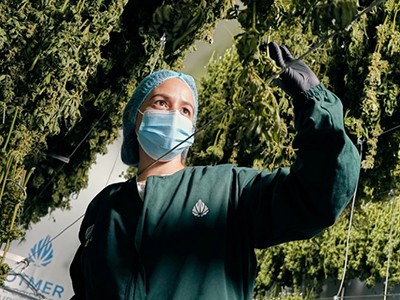
Decriminalization of marijuana opens doors for some scientists
First, she had to work out how to deliver mushrooms to meet the FDA’s dosing standards. But there was no published protocol for this.
Nicole Nichols, executive director of the Scottsdale Research Institute, grows edible mushrooms and volunteered to develop such a protocol. Initially, she and Sisley tried delivering mushrooms in a warm tea, but the results were erratic. Then they tried using pills, but realized that it would take 18 capsules to deliver the required dose.
Eventually, they experimented with chocolate, which masked the mushrooms’ unpalatable flavour and served as a protective wrap that stabilized psilocybin. After consistently hitting the FDA’s dosing requirements, they published their protocol (R. Goff et al. Anal. Chim. Acta 1288, 342161; 2024).
“We’re getting inquiries from investigators all over the world who want access to federally legal mushrooms that are standardized,” says Sisley.
Meanwhile, after completing the 2019 cannabis trial, Sisley and MAPS received $13 million from the state of Michigan in 2021, for a phase IIb cannabis study for veterans with PTSD and pain. That trial also ran into a roadblock when the FDA objected to a part of Sisley’s protocol that would allow participants to self-titrate their dose. Insistent that this was the right way to do the study, Sisley hired lawyers. Last December, the FDA relented, allowing the trial to move forward. Sisley plans to enrol participants this year.
Be fearless
“If you want to study drugs that have been criminalized by our government, you must be fearless,” says Sisley, who credits her success to creative thinking and building coalitions.
In 2023, together with Kevin Payne, a Republican politician and at the time a member of the Arizona state House of Representatives, Sisley drafted legislation, HB2486, to designate state funding for whole-mushroom psilocybin research. She says there was a backlash from other groups competing for funding, because the state had a budget deficit at the time.
“But we believed there was enough support from the public,” she says. “We stood shoulder to shoulder with military veterans, firefighters, retired and disabled police, who all wanted access to this research.”

Dodger, Sisley’s former guide dog, often accompanied her when she spoke to the public or lawmakers.Credit: SRI Foundation
The bill passed, and the state awarded Sisley $2.75 million for a trial of the mushrooms to treat severe PTSD, pain and suicidality. She anticipates that it will begin later this year.
As for scientists who have failed to secure US National Institutes of Health grants, or who find that their funding is on hold because of freezes by the Trump administration, Sisley encourages them not to wait, but to actively seek out philanthropic funding and propose their own legislation.
“State legislatures want to show that they’re in the lead on science that could uncover treatments immediately,” she says. “The problem is, lawmakers may view scientists as aloof and arrogant. That’s what we must change.”
So, Sisley walks the halls of the Arizona state capitol, developing relationships with lawmakers. She educates them about the need to move science forward and create a path to FDA approval for Schedule I drugs.
“You have to be as much of an activist as you are a scientist,” she says, “because otherwise you’re not going to progress.”
And Sisley keeps pushing. In March, she returned to South by Southwest to discuss ibogaine, a psychoactive compound derived from the iboga shrub (Tabernanthe iboga), that she thinks could help to mitigate the US opioid crisis. Nearly 727,000 people in the United States died from an opioid overdose between 1999 and 2022.
When Suboxone — a combination of the drugs naloxone and buprenorphine — came on the US market in 2002, she was excited to have something to help to control opioid withdrawal symptoms. “But I’ve had patients who have been stuck on Suboxone for over 20 years, desperately trying to taper themselves off,” she says.
That’s where Sisley says ibogaine could help. Some people have reported being cured of their opioid addictions after a single ibogaine therapy session. But it is a Schedule I drug and unavailable in the United States.
Sisley sees an opportunity for ibogaine studies to be financed by the very drug companies, distributors and retailers that fuelled the opioid crisis. Legal settlements require those companies to provide about $57 billion to US states over 18 years.
“A small portion of that could really help advance research,” says Sisley.
The passion Sisley brings to her research means she’ll keep seeking creative ways to help those whose lives have been wracked by PTSD, pain and addiction. “I don’t ever want to stop seeing patients,” she says. “They teach me so many things.”
Nature 641, 267-269 (2025)
doi: https://doi.org/10.1038/d41586-025-01298-3
Revolutionary Research on the ECS, cannabinoids and cannabis-based medicine for healthcare from a trusted nonprofit.
