
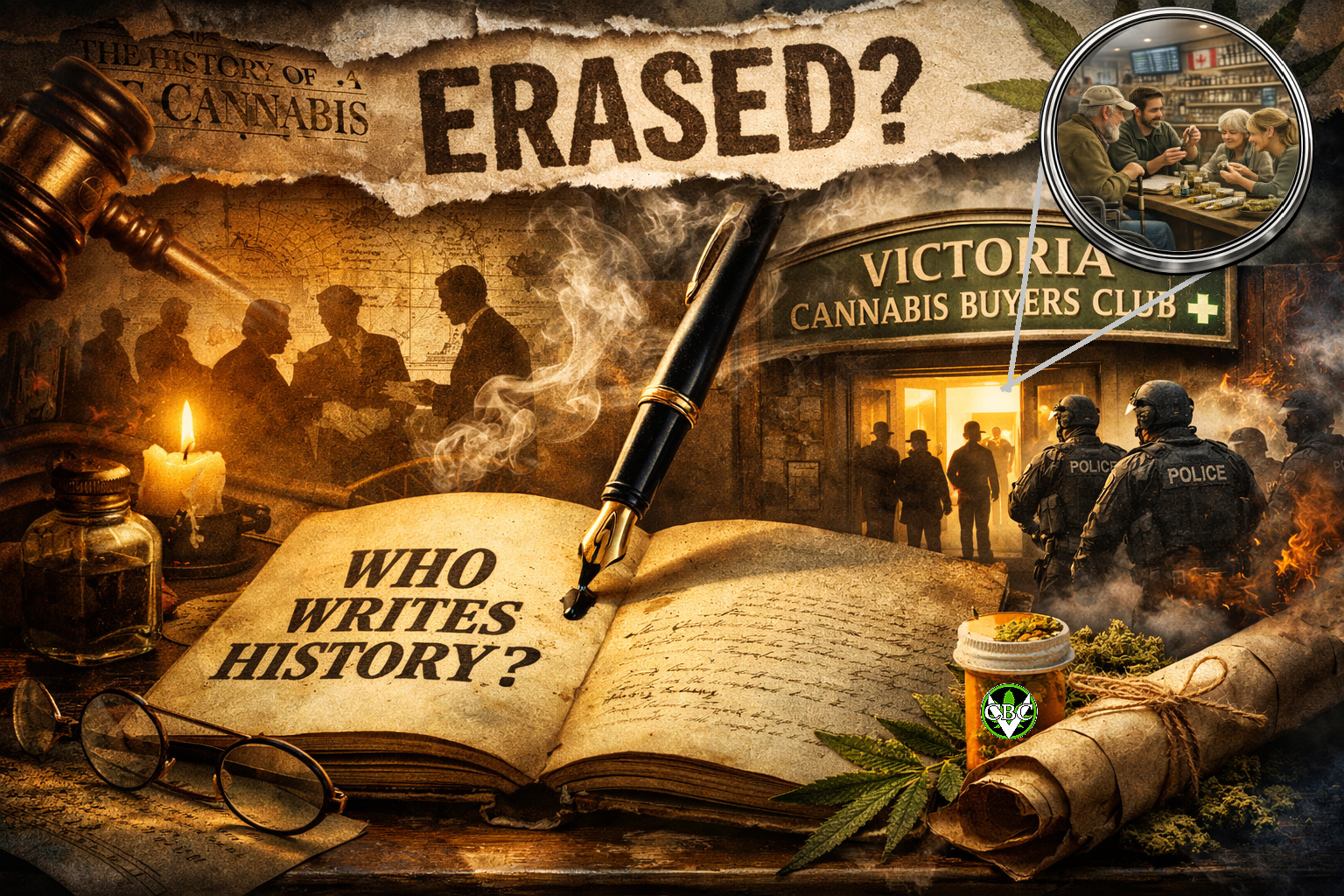
 Compassion Clubs in Canada: When Narrative Can Be Mistaken for Truth
There is a dangerous shift continuing in how Canada’s medical cannabis history is being told.
Not confusion.
Not nuance.
A rewriting.
And this time, it is not coming from outsiders.
It is coming from within.
Rielle Capler is not a random outside commentator. She has worked in cannabis and drug policy for more than 20 years and currently serves as Executive Director of MAPS Canada. She is also listed as an adjunct faculty member at the University of British Columbia, and past bios and disclosures connect her to the B.C. Compassion Club Society and the Canadian Association of Medical Cannabis Dispensaries. That history is exactly why her public framing of compassion clubs carries weight, and why leaving out the continued existence of the Victoria Cannabis Buyers Club is not a minor omission, but a serious one.
History, in general, has always belonged to whoever holds the pen last.
They don’t just record events. They shape them. Rewrite them. Decide what gets remembered and what gets left out. The history of cannabis seems no different.
We’ve seen this before in history and in the books that record it. Entire narratives once accepted as truth have later been exposed as incomplete, biased, or flat out wrong.
This is one of those moments…
This is not coming from someone unfamiliar with compassion clubs. Rielle Capler has previously co authored work acknowledging their importance to patient care. Which makes the current framing even more difficult to ignore.
So, when Rielle publicly described compassion clubs as something that “disappeared” after legalization, it did more than oversimplify history.
It erases what still exists.
Because compassion clubs did not disappear.
Some closed. Many not by choice.
Some “transitioned”.
Some stepped away.
And one refused to abandon patients…
The Victoria Cannabis Buyers Club is still operating today. More than 30 years strong.
That fact alone contradicts the claim.
This matters because patients are still fighting for access. It matters because history shapes policy. And when a surviving compassion club is erased from public discussion, the people who depend on it are erased too.
When Language Becomes Erasure
Words matter.
Especially when they come from someone with influence.
Referring to compassion clubs in the past tense, or suggesting their “disappearance,” creates a false sense of finality. It tells the public, policymakers, and researchers that the model is over.
It is not.
And when the continued existence of the Victoria Cannabis Buyers Club is not acknowledged in that framing, it becomes more than an oversight.
It can function as exclusion
It tells the public, researchers, policymakers, and patients that the last major surviving compassion club does not count. That is why wording like this cannot be brushed off as harmless shorthand.
The Response That Didn’t Come
What makes this worse is what followed.
After being directly challenged, there was time to clarify. Time to correct. Time to acknowledge that at least one major compassion club in Canada is still active.
That correction never came.
Instead, the original framing was allowed to stand.
In the public thread, some attempted to soften the interpretation. Suggesting it meant “most” clubs are gone. That it was just historical shorthand.
But that is not what was written.
And precision matters.
“Disappeared” is not the same as “many closed.”
One acknowledges survival.
The other erases it.

Public thread showing Ted Smith responding to discussion about compassion clubs and challenging misleading claims about their disappearance
What the Thread Made Clear
This wasn’t a misunderstanding.
The issue was raised directly. Clearly. Publicly.

Ted Smith states that despite being challenged, no correction was made to claims about compassion clubs being gone
There was time to correct the wording.
There was time to acknowledge that compassion clubs still exist.
No public correction was made.
Instead, the statement stood as written.
That matters.
Because when a claim is challenged and left uncorrected, it stops appearing as an oversight.
It can reasonably be interpreted as a position.
Not Shut Down. Not Gone. Not Finished.
Let’s be clear about what actually happened after legalization.
Compassion clubs were not universally shut down by government force.
Some closed before facing enforcement.
Some chose to transition into the legal market.
Some lost support or direction.
The Victoria Cannabis Buyers Club stayed.
The VCBC endured raids, eviction, legal pressure, and millions in fines.
And it reopened.
Every time.
That is not disappearance.
That is commitment to patients.
A Pattern That Didn’t Start Today
This moment is not isolated.
There is a long-standing pattern where the VCBC has been minimized, overlooked, or excluded from broader discussions about compassion clubs in Canada.
From early claims about when compassion clubs began, to who is recognized as foundational, to which organizations are centered in public and academic narratives.
This did not start with one post.
But this post reflects that pattern continuing.
It reflects a much older problem in which the VCBC has too often been ignored, minimized, or pushed aside by better known figures in cannabis reform and drug policy.
The Fight Over History
At the heart of this dispute is a deeper fight over who gets remembered and who gets written out.
Ted Smith corrects the claim that compassion clubs in Canada began in 1997.
He says the VCBC began in January 1996 while he was living in a van, and that it was the first public compassion club in Canada.
He also points out that the VCBC helped establish a more realistic patient access model by requiring proof of diagnosis for a serious medical condition rather than a doctor’s recommendation at a time when many physicians would not even discuss cannabis as medicine.
This Is Not a War
Some responses suggested that calling this out is “starting a war.”
It is not.
It is insisting on accuracy.
When an organization that has served patients for over three decades is omitted from the present tense of the conversation, correcting that is not aggression.
It is responsibility.
What Legalization Didn’t Replace
Legalization changed the structure of access.
But it did not replace what compassion clubs provided.
Patients still face:
High costs
Limited product options
Barriers to meaningful access
A system that often fails to reflect real medical use
That is why the Victoria Cannabis Buyers Club still matters.
Because the need never disappeared.
Legalization did not preserve storefront medical access. For many patients, legal access became narrower, more impersonal, and less flexible, with mail order as the main legal route and edible limits that remain far too low for serious medical use.
The VCBC Did Not Just Survive. It Helped Change Canada.
The VCBC was not just present during the fight for medical cannabis access.
It helped move that fight forward.
Ted connects the club to the Owen Smith case, one of the most important cannabis legal battles in Canadian history.
That case helped establish the rights of patients to access extracts and edibles, not just dried cannabis.
VCBC is not dead, far from it. – Ted Smith
Still Here. Still Evolving.
The VCBC is not a relic.
It is evolving.
By integrating pharmacists and adding third party oversight, it has created a hybrid model that bridges patient driven care with professional accountability.
That is not outdated.
That is forward thinking.
By bringing pharmacists into screening and medication review, the VCBC has strengthened the compassion club model rather than replacing it, adding expert oversight while preserving patient-centered care.
Lives Are Not Historical Footnotes
This is not about narrative control.
It is about patients.
People living with cancer.
Multiple sclerosis.
Arthritis.
PTSD.
And many other serious, chronic, and treatment resistant conditions that still drive patients toward compassion based access because the legal framework continues to fail them.
People who rely on access that still does not exist within the legal framework.
When compassion clubs are written out of the present, those people are written out with them.
And when the systems that serve them are ignored, they become easier to neglect in law, research, and public policy.
Setting the Record Straight
The Victoria Cannabis Buyers Club was there at the beginning.
It helped define medical cannabis access in Canada before the system allowed it.
It fought legal battles that expanded patient rights.
And it is still here.
Not as a memory.
As reality.
The VCBC is not a relic of the compassion club movement in Canada. It is its living continuation. If Canada is serious about patient-centered reform, it should be recognized, defended, and studied, not erased.
Final Word
This is not about attacking individuals.
But it does require naming them when their words shape public understanding.
Because influence comes with responsibility.
This is not about tone or disagreement.
It is about refusing to let active, patient-serving organizations be written out of the present.
History does not disappear because it is framed differently.
And compassion does not end because it is spoken about in the past tense.
If the goal is progress, then the truth has to include what still exists.
Anything less is not just incomplete.
It is misleading as written.
When a public statement misrepresents reality in any professional field, correcting it is not optional. It is honest, professional, and necessary. I hope this blog leads to that correction, here and elsewhere, in Canadian cannabis advocacy.
Author’s Note: A Patient’s Truth After Legalization:
I am writing this to document a patient perspective that is too often overlooked, and to challenge how this system and its history are being represented today.
I was among the earliest federally authorized medical cannabis patients in Canada, part of the original wave under the country’s first recognized program. I have witnessed the so-called evolution of medical access from its earliest forms to where it stands today and from a patient perspective, it has not meaningfully improved.
In those early days, what was provided as “medical cannabis” was often inconsistent, poorly processed, and difficult to tolerate. It was far from the standard patients deserved, and far from what a true medical system should have been.
What improved conditions for patients was not top down design, but patient pressure, compassion clubs, and people willing to build something better outside of a system that was not meeting real needs. Early policy analysis has shown that federal programs struggled to meet patient needs, while community-based dispensaries were already serving far more patients despite operating without legal protection.
Research by Philippe Lucas also warned that the federal model was becoming a restrictive, non beneficial monopoly on production and distribution, including a reported 1500 percent markup charged to patients on government contracted cannabis.
Over time, as legalization took shape, many expected that progress to continue. Instead, for many patients, access became more restricted, more impersonal, and more limited in meaningful ways. Evidence shows that Canada’s medical cannabis system declined following non-medical legalization, with decreases in patient registrations and persistent barriers such as higher costs, reduced product suitability, and difficulty navigating the legal system. At the same time, the non-medical retail market expanded rapidly, capturing a significant share of cannabis access and shifting focus away from patient-centered care.
There is also evidence that increasing commercialization has been associated with new challenges and harms, reinforcing concerns that the post-legalization system has not been designed primarily around patients. This has deepens concerns about a system that has evolved into a restrictive, non beneficial monopoly that prioritizes control and profit over patient care.
Today, there are hundreds of thousands of registered medical cannabis patients in Canada, yet many still face barriers that compassion clubs were originally created to address.
There is a broader concern behind this as well. When history is framed inaccurately, especially by those with influence, it does more than misinform; it reshapes public understanding and policy direction. In a space where compassion-based access has already declined, describing these models as if they have disappeared risks reinforcing that decline. Over time, this kind of framing becomes a form of historical whitewashing, actively minimizing or excluding what still exists and what continues to serve patients.
There is also a wider dynamic at play. Public voices in cannabis policy and reform carry real influence in how systems are understood and how their histories are remembered. When influential figures describe compassion based models in the past tense, it can align with a system that has become increasingly structured around regulation, commercialization, and centralized control.
In that environment, patient driven models, the very foundation that helped establish access in Canada, risk being pushed aside in both policy and public understanding. This raises a necessary question. Whose experiences and contributions are being centred, and whose are being left out as the current system continues…
For years, as one of many patients and caregivers, I’ve been speaking out about my deep disappointment with cannabis legalization, not just for myself, but for and with patients across the board.
After seeing Ted’s post, it hit a nerve. It laid bare how a broken system continues to weave its web, favouring itself and its affiliates far more than the very people it was supposed to protect. Ensuring their futures but not helping the future of patients in Canada.
At my age, I’ve watched long enough to know how easily history can be skewed. What we grew up believing as truth is too often reshaped, softened, or outright rewritten to serve those in power. The same pattern may be playing out here, where narratives are being adjusted to protect investors and their interests, while patients are once again left behind.
What also concerns me is seeing people who were once part of the advocacy movement now retelling that history inaccurately. Not by accident, but knowingly. That shift matters. It also shows how many so called activists and advocates jumped ship, trading principle for profit within the very system they now magically defend.
And when you look closer, it reflects a broader trend since legalization. Many so called advocates walked away when the real work should have deepened. Drawn in by money, opportunity, and influence within these oligopolistic systems, they traded purpose for position. Sold a passion for glory.
Meanwhile, patients are still here. Still waiting. Still carrying the weight of a system that promised better, but delivered something else entirely.
This is not the system patients built. It is the system patients were pushed into.
I wrote this, not to speak for Ted Smith, but as a patient, to stand alongside what we both have been saying for decades, and from years of watching history be rewritten and misrepresented, to ensure that what still exists, and what still serves patients, is not spoken about as if it no longer does.
Patients still rely on compassion clubs and patient driven access.
As these models face growing threat, they are spoken about as if they no longer exist.
Clearing the board for Health Canada, its industry partners, and a system shaped by monopoly interests.
This is not just narrative.
It is erasure in real time for cannabis patients in Canada.
Cannabis in Canada looks increasingly like an oligopolistic, heavily regulated, license constrained market with cartel like dynamics.
LONG LIVE THE VCBC!!!!!!!
