
Modified Hemp Fabric Could Replace Toxic Synthetics
 Modified hemp is revolutionizing sustainable textile science. In a recent breakthrough, researchers transformed hemp fabric into a high-performance material that resists fire, blocks UV light, repels water, and stays toxin-free. This is more than fabric; it’s a plant-based answer to toxic synthetics.
Cosmetic potential meets critical safety innovation in a new study that redefines what hemp textiles can do. Researchers have developed a flame-retardant, UV-blocking, and superhydrophobic hemp fabric using a non-toxic, eco-friendly method, achieving unprecedented performance without fluorinated chemicals or synthetic additives.
This breakthrough goes beyond fabric; it sets a new benchmark for sustainable material science. It’s a direct response to the global call for safe, sustainable, and multifunctional materials in everything from home decor to public infrastructure. And it all starts with hemp; a plant already known for its regenerative growth, strength, and environmental benefits.
A New Era for Modified Hemp: Multifunctional and Clean
In this 2025 materials science study, researchers introduced a nonfluorinated, green method to engineer next-generation hemp textiles. By coating hemp fabric (200 g/m², 0.3 mm thick) with the metal–organic framework NH₂-MIL-53(Al) and modifying the surface with triethoxyoctylsilane (TEOS), they created SM(Al)HF-9; a high-performance hemp fabric that resists fire, UV damage, and moisture, while remaining self-cleaning and non-toxic.
This marks the first reported instance where a single MOF – NH₂-MIL-53(Al) – was able to impart such high flame resistance to hemp fabric without needing additional chemical modifiers. That’s not just innovation – it’s proof that clean chemistry can outperform synthetic complexity.
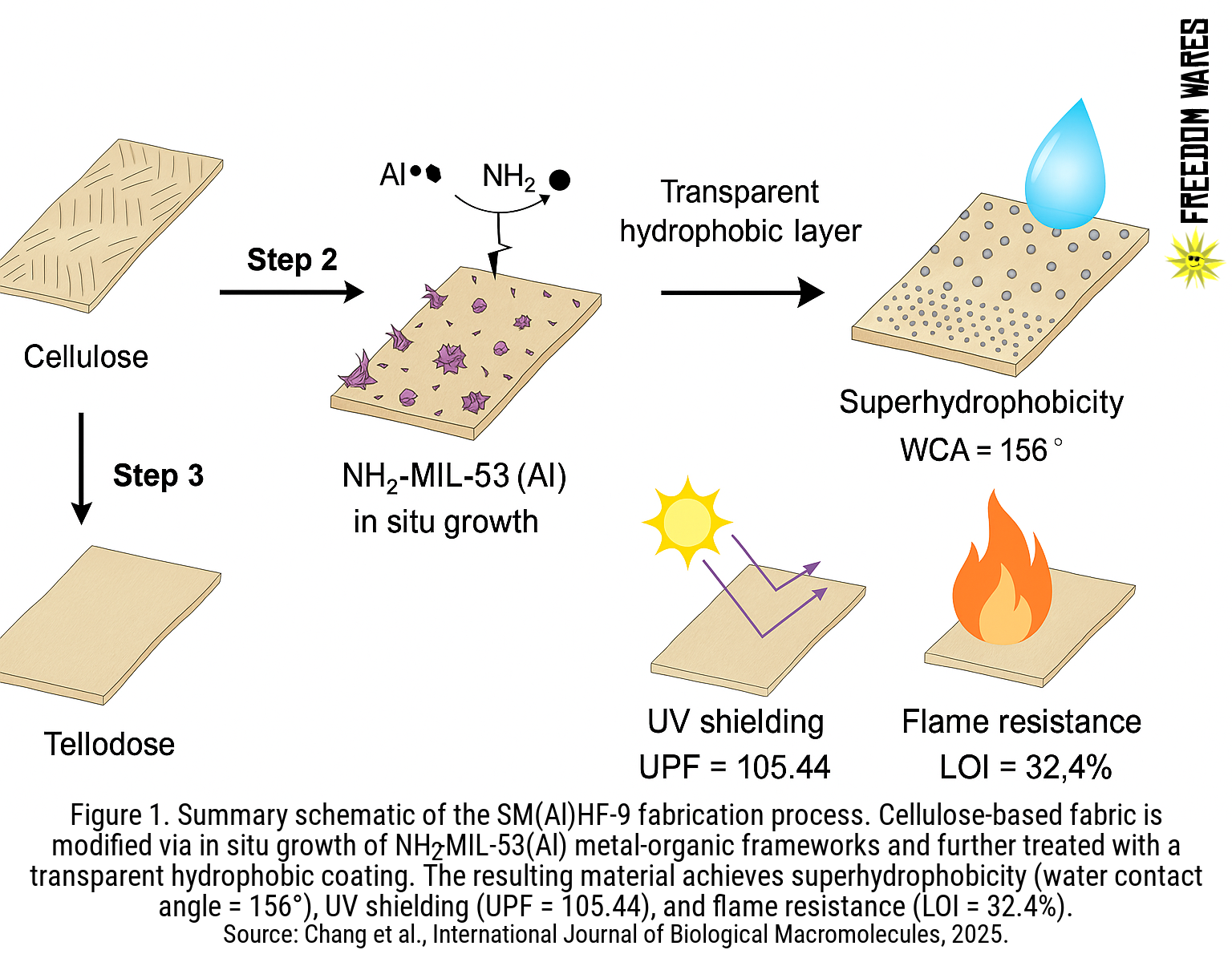
Three-step hemp fabric modification yielding fire safety, UV protection, and water repellency
Here’s what they achieved:
- Superhydrophobicity: Water simply rolls off the surface with a contact angle of 156°, preventing absorption, mold, and microbial buildup.
- Self-cleaning properties: SM (Al)HF-9 resists adhesion from powder and dye, meaning it naturally repels dirt, liquids, and even pollutants.
- UV protection: With a UV Protection Factor (UPF) of 105.44, this hemp textile rivals commercial-grade sun barriers, without synthetic coatings.
- Flame retardancy: The fabric demonstrated self-extinguishing behavior and a Limiting Oxygen Index (LOI) of 32.4%, drastically reducing flammability.
- Heat safety: Compared to raw hemp fabric, the Peak Heat Release Rate (PHRR) dropped by 76.15%, and Total Heat Release (THR) by 54.32%; significant for any fire-prone environment.
 Oil–water separation: The porous SM(Al)HF-9 separated oil–water mixtures with over 97% efficiency, suggesting spill-cleanup and filtration potential.
**Figure 4.** Oil–water separation efficiency of SM(Al)HF-9 modified hemp fabric using n-hexane and tetrachloromethane mixtures. Separation efficiency exceeded 97%. Source: Chang et al., *International Journal of Biological Macromolecules*, 2025.

 Why NH₂-MIL-53(Al) Wins Over Other MOFs
The study compared NH₂-MIL-53(Al) to several other MOFs including ZIF-67, Ce-MOF, Ag-MOF, Fe-MOF, and even MIL-53(Al) itself. The results showed NH₂-MIL-53(Al) to be superior in flame resistance and environmental stability. This material bonded evenly to the hemp fiber, creating a uniform and compact coating that held up in real-world humidity and wear simulations.
Importantly, this was achieved without using fluorine-based compounds, which are under increasing scrutiny for their toxicity, persistence in the environment, and links to human health risks. Traditional treatments like PDMS often require solvents like THF, which pose handling and environmental hazards. Fluorinated silanes, once common in water-resistant coatings, are increasingly being banned worldwide.
Real-World Applications: Safer Interiors, Smarter Design
Imagine curtains that self-extinguish in a fire, clothing that blocks cancer-causing UV rays, and furniture upholstery that repels spills – all without introducing toxins into your home or body. Now imagine that all of it is made from hemp.
This is not a futuristic vision. It is a proof-of-concept, backed by data, showing hemp textiles can meet the toughest demands of fire safety, weather resistance, and environmental standards, while staying natural and clean.
Potential applications include:
- Fire-safe home furnishings
- UV-resistant outdoor gear and awnings
- Chemical-free clothing for heat- and sun-sensitive individuals
- Reusable oil – water filters for eco-industry applications.
- Public infrastructure where flame resistance and moisture protection are critical
 Hemp Deserves the Spotlight in Textile Innovation
In a world of microplastics, perfluorinated toxins, and fast fashion, this hemp-based fabric stands as a blueprint for plant-based innovation. It proves that green chemistry and performance can coexist, and that hemp is not just a nostalgic fiber from the past but a technological ally for the future.
As governments and industries scramble for sustainable solutions, the answer may already be growing in our fields. Hemp, when combined with clean science, is ready to replace synthetic performance fabrics and do it without compromise.
Freedom Wares Takeaway

Microscopic view of NH₂-MIL-53(Al) crystals anchored to hemp fibers—these needle-like structures are key to the fabric’s flame resistance, UV shielding, and water-repelling power.
This isn’t just about textiles. It’s about public safety, planetary health, and a return to botanical logic. The era of toxic treatments and fire-prone synthetics must end. With hemp and materials like NH₂-MIL-53(Al), we are one step closer to a cleaner, safer world – one fiber at a time.
Study Reference
Chang, J., Qin, Y., Guo, W., Zhang, J., Zhang, K., Zheng, J., Sun, L., & Fu, Q. (2025). Green fabrication of highly flame-retardant, anti-ultraviolet radiation and superhydrophobic cellulose-based fabric by constructing dual-*tielement-containing NH₂-MIL-53(Al)@Triethoxyoctylsilane nano coatings. International Journal of Biological Macromolecules, 265, 143560.
(*The term “tielement” refers to the dual role of aluminum (Al) and silicon (Si) in the composite coating structure.)
https://doi.org/10.1016/j.ijbiomac.2025.143560

Revolutionary Research on the ECS, cannabinoids and cannabis-based medicine for healthcare from a trusted nonprofit.
