

doi: 10.1038/s41598-025-96761-6.
Optimal nitrogen rates and clonal effects on cannabinoid yields of medicinal cannabis
- PMID: 40210892
- PMCID: PMC11985917
- DOI: 10.1038/s41598-025-96761-6
Abstract
Nitrogen (N) nutrition and germplasm of clones can influence biomass and cannabinoid concentration in medicinal cannabis. However, there are discrepancies on the optimal nitrogen (N) application rate at the flowering stage to achieve maximum yield and if, or how, this interacts with clones from different seed lines of the same genotype. This research examined the relationship between N application rate, concentration of cannabinoids and biomass yield of a CBD-type medicinal cannabis cultivar in clones propagated from five different seed lines (hereafter referred to as clones).
Clonal rooted cuttings were propagated from five mother plants germinated from seeds of cultivar ‘Tas1’. Five N levels (30, 90, 160, 240 and 400 mg/L N) were imposed at the start of the inflorescence period and continued until harvest eight weeks later. Some pollen contamination occurred during the trial so that seed biomass was assessed for each plant and included in statistical analysis. Weight of total biomass, leaves and inflorescence (from upper and lower canopy positions), N%, and cannabinoid concentrations were measured after the harvest.
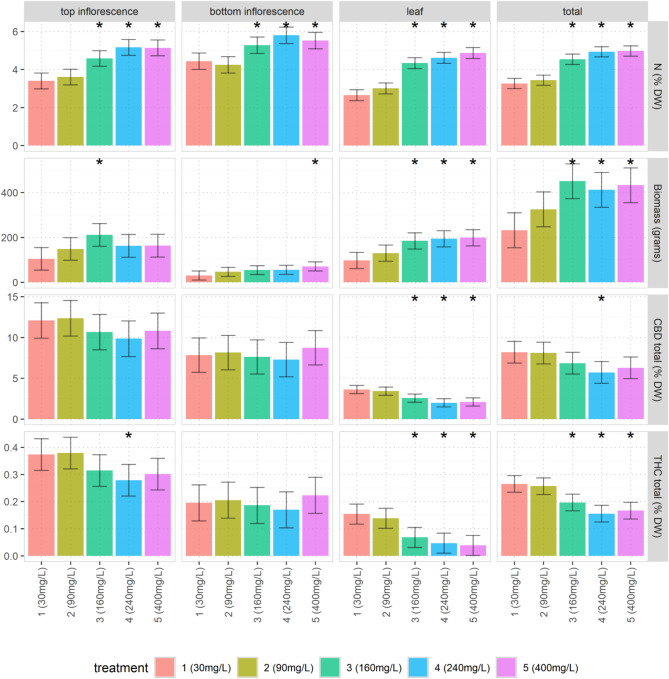
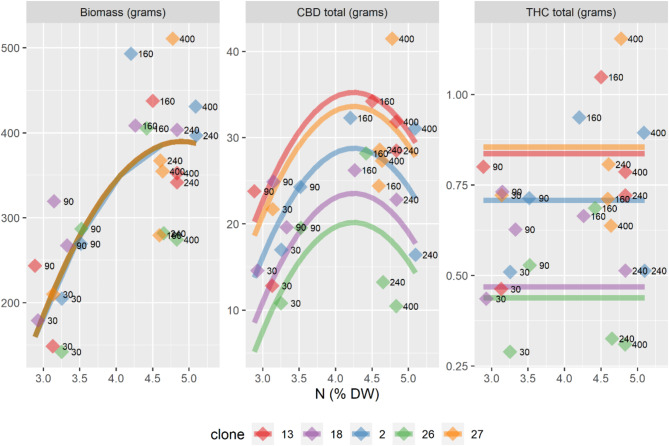
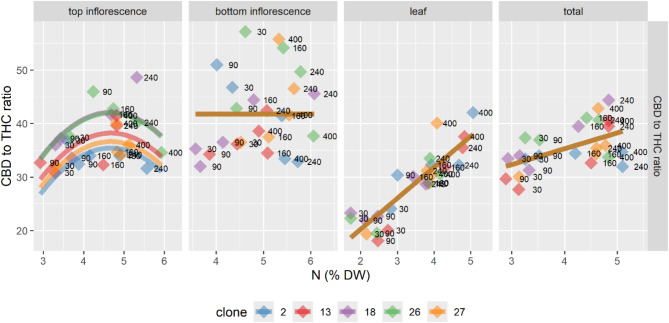
Results indicated that increasing N supply generated a clear upward trend in inflorescence biomass that peaked at 160 mg/L N after which it did not significantly change, while leaf biomass steadily increased with N. Delta9-tetrahydrocannabinol (THC) and cannabidiol (CBD) concentrations decreased significantly with increasing N concentration in leaves with a similar, but non-significant, trend for inflorescences. The CBD to THC ratio increased with increased N. Clone source was strongly correlated with cannabinoid concentration, but not leaf, inflorescence or total biomass, across all N treatments. Clones 13 and 27 developed greater cannabinoid concentrations relative to clones 18 and 26 irrespective of N treatment. Pollen contamination induced seed development that comprised up to 5% of inflorescence biomass dry weight but this did not significantly affect whole-plant biomass, N accumulation (N%), or cannabinoid concentration. These findings provide valuable insights for improving cannabinoid yield in this widely cultivated plant species.
Keywords: CBD, Fertigation, Inflorescence, Nitrogen nutrition, Pollen contamination, THC
© 2025. The Author(s).
Conflict of interest statement
Declarations. Competing interests: The authors declare no competing interests. Ethical approval: The research was conducted under a medicinal cannabis licence and permit issued to Martha Jane Medical by the Australian Office of Drug Control and an industrial hemp licence issued to the University of Tasmania under the Tasmanian hemp legislative framework. The plant collection and use were in accordance with all the relevant institutional, national, and international guidelines and legislation. Permissions or licenses were obtained for the collection of plant material, and the voucher specimen was stored at the University of Tasmania under licence number IHR081. All the original plant material (seeds) used in this research was provided by its commercial owner, Martha Jane Medical, Australia.
Figures
Impact of Nitrogen on Cannabinoid Yield and Biomass in Medicinal Cannabis
Overview of the Study:
Nitrogen (N) nutrition plays a significant role in the growth and cannabinoid concentration of medicinal cannabis. However, the optimal nitrogen application rate at the flowering stage remains a subject of debate. This study focused on a CBD-type medicinal cannabis cultivar, examining how different nitrogen levels affect biomass yield and cannabinoid concentration in clones propagated from five different seed lines of the same genotype.
Study Methodology:
Clonal rooted cuttings were taken from five mother plants of cultivar Tas1. The researchers applied five nitrogen levels (30, 90, 160, 240, and 400 mg/L) starting at the beginning of the inflorescence period and continued until harvest eight weeks later. The study measured the weight of total biomass, leaves, inflorescences, nitrogen concentration (N%), and cannabinoid concentrations at harvest.
Key Findings:
-
Inflorescence Biomass: Increasing nitrogen levels led to an upward trend in inflorescence biomass, peaking at 160 mg/L N. Beyond this level, the increase in biomass plateaued.
-
Leaf Biomass: Leaf biomass steadily increased with higher nitrogen levels, highlighting the significant role nitrogen plays in leaf production.
Cannabinoid Concentration:
-
Decreasing THC and CBD: Both THC and CBD concentrations significantly decreased in the leaves with increasing nitrogen levels. In inflorescences, the decrease was non-significant but still apparent.
-
CBD to THC Ratio: Interestingly, the CBD to THC ratio increased with higher nitrogen levels, which could be an important factor for medical cannabis growers looking to manipulate cannabinoid profiles.
Genetic Clonal Influence:
-
Clonal Variation: The genetic source of the clones had a strong correlation with cannabinoid concentration. Clones 13 and 27 consistently developed higher cannabinoid concentrations, regardless of nitrogen treatment, whereas clones 18 and 26 had lower concentrations.
Pollen Contamination:
-
During the trial, pollen contamination induced seed development, contributing up to 5% of the inflorescence biomass dry weight. However, this did not significantly affect whole-plant biomass, nitrogen accumulation, or cannabinoid concentration, showing that pollen contamination had minimal impact on the study’s outcomes.
Key Takeaways:
-
Moderate Nitrogen Feeding: The optimal nitrogen level for flower biomass is around 160 mg/L, where biomass peaks without sacrificing cannabinoid yield.
-
Impact on Cannabinoid Yield: Excessive nitrogen can reduce cannabinoid concentration, particularly in leaves, but also slightly in inflorescences.
-
Genetic Selection: Clonal genetics significantly influence cannabinoid output. Some clones naturally produce higher concentrations of cannabinoids, regardless of nitrogen levels.
-
Pollen Contamination: Although pollen contamination contributed to seed development, it did not negatively affect the biomass or cannabinoid yield in a significant way.
Implications for Cultivators:
These findings underline the importance of both nutrient management and genetic selection for optimizing cannabinoid production in medicinal cannabis. By adjusting nitrogen levels carefully and selecting high-yielding clones, cultivators can increase both biomass and cannabinoid yield without compromising the quality of their crop. Additionally, growers need to be mindful of pollen contamination, though its effects may be minimal.
This research provides valuable insights that can help growers fine-tune their cultivation practices to improve both the quantity and quality of their medicinal cannabis.

Revolutionary Research on the ECS, cannabinoids and cannabis-based medicine for healthcare from a trusted nonprofit.
