
How Cannabis Knows When to Make Cannabinoids
Environmental and hormonal signals may hold the key to unlocking cannabinoid yield—naturally.
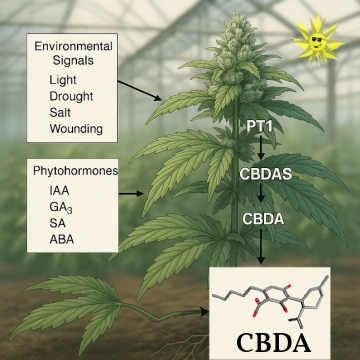 Cannabis doesn’t produce cannabinoids by accident. A new study shows that Cannabis sativa possesses built-in genetic switches that decide when, where, and how much CBD and related compounds are produced. This discovery is reshaping how we understand cannabinoid expression — and how we might improve it, naturally.
Cracking Open the Promoter Code
Researchers focused on the promoter regions of two key genes:
-
CBDAS (cannabidiolic acid synthase), which drives CBD production
-
PT1 (prenyltransferase), which catalyzes precursor steps for both CBD and THC
By linking these promoters to a GUS reporter system in Nicotiana tabacum (tobacco), the team could visualize where and how gene expression was activated in response to different signals. What they found was remarkable: strong promoter activity in leaves, flowers, and glandular trichomes, mimicking the natural cannabinoid production zones in cannabis.
The Plant’s Internal Messaging System
The study revealed that both internal signals (phytohormones) and external stressors (like drought and light exposure) influence cannabinoid gene expression:
-
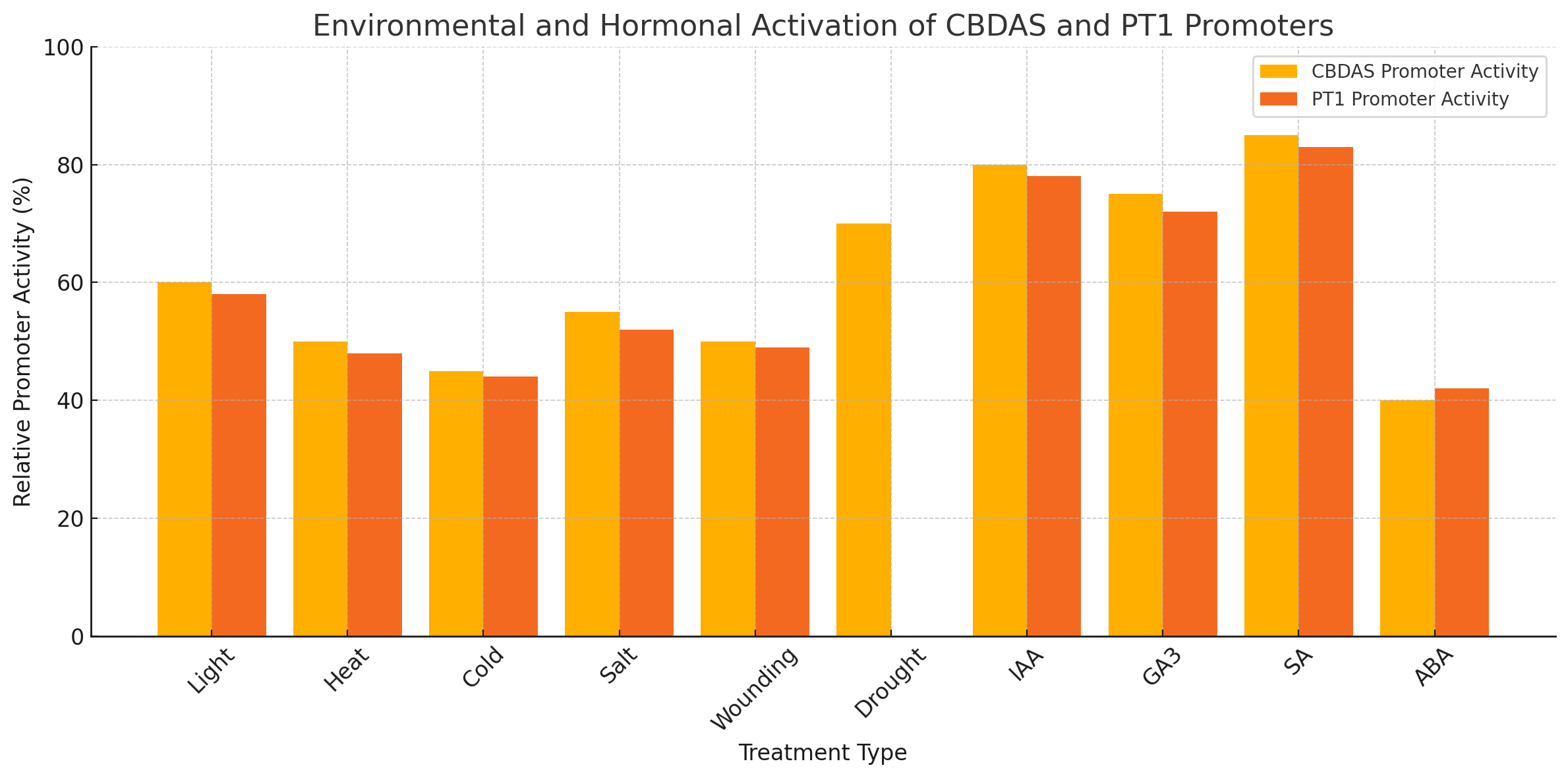
IAA (auxin), GA₃ (gibberellic acid), SA (salicylic acid), and ABA (abscisic acid) significantly activated both CBDAS and PT1 promoters
-
Environmental triggers including light, salt, heat, cold, and wounding also induced activation
-
Notably, drought stress activated CBDAS only — not PT1 — suggesting a unique stress-cannabinoid relationship
This paints a clear picture: Cannabis sativa doesn’t just react passively to its environment. It adjusts cannabinoid output in real time based on surrounding conditions and internal signals.
Visualizing the Activation Pattern
Below is a side-by-side comparison of CBDAS and PT1 promoter responses under different treatments. This data helps visualize which inputs activate cannabinoid gene expression most effectively.

Environmental and hormonal activation of CBDAS and PT1 promoters. While both genes respond to light, temperature changes, salt, and several plant hormones, only CBDAS is activated by drought stress.
What This Means for Breeding, Cultivation, and Natural Medicine
This discovery is far from theoretical. It offers major implications for:
-
Clean breeding: Select strains that are naturally responsive to environmental cues
-
Precision cultivation: Time light, water, or foliar applications to naturally trigger cannabinoid expression
-
Yield enhancement: Boost medicinal compound output without genetic modification or chemical enhancers
By understanding the signals that cannabis already uses to regulate itself, we can support the plant rather than manipulate it — aligning cultivation with the plant’s own rhythm.
 Source and Reference
Source: The promoter regions of CBDAS and PT genes of cannabinoid biosynthesis in Cannabis sativa respond to phytohormones and stress-related signals [PMID: 40349291]

Revolutionary Research on the ECS, cannabinoids and cannabis-based medicine for healthcare from a trusted nonprofit.
